My first real exposure to the art of the American West came at the Rockwell Museum in Corning, New York. I knew of the big names and the big paintings but suffered the insularity that many of us suffer in the places we were born. As a child of the East Coast of Massachusetts, we always joked that there was no culture west of the Berkshires which, mercifully, buffered us from the neighboring state of New York. That was before I spent more than 30 years working in museums and cultural institutions across the state of New York.
Insularity and exclusion is a thing of the past in museums as they make connections—among works of art and with the public that comes to look at them. I asked Erin Coe, executive director of the Rockwell, to tell me about how the collection of Bob and Hertha Rockwell, originally displayed in his department store, evolved into the vibrant, community-oriented museum it is part of today.
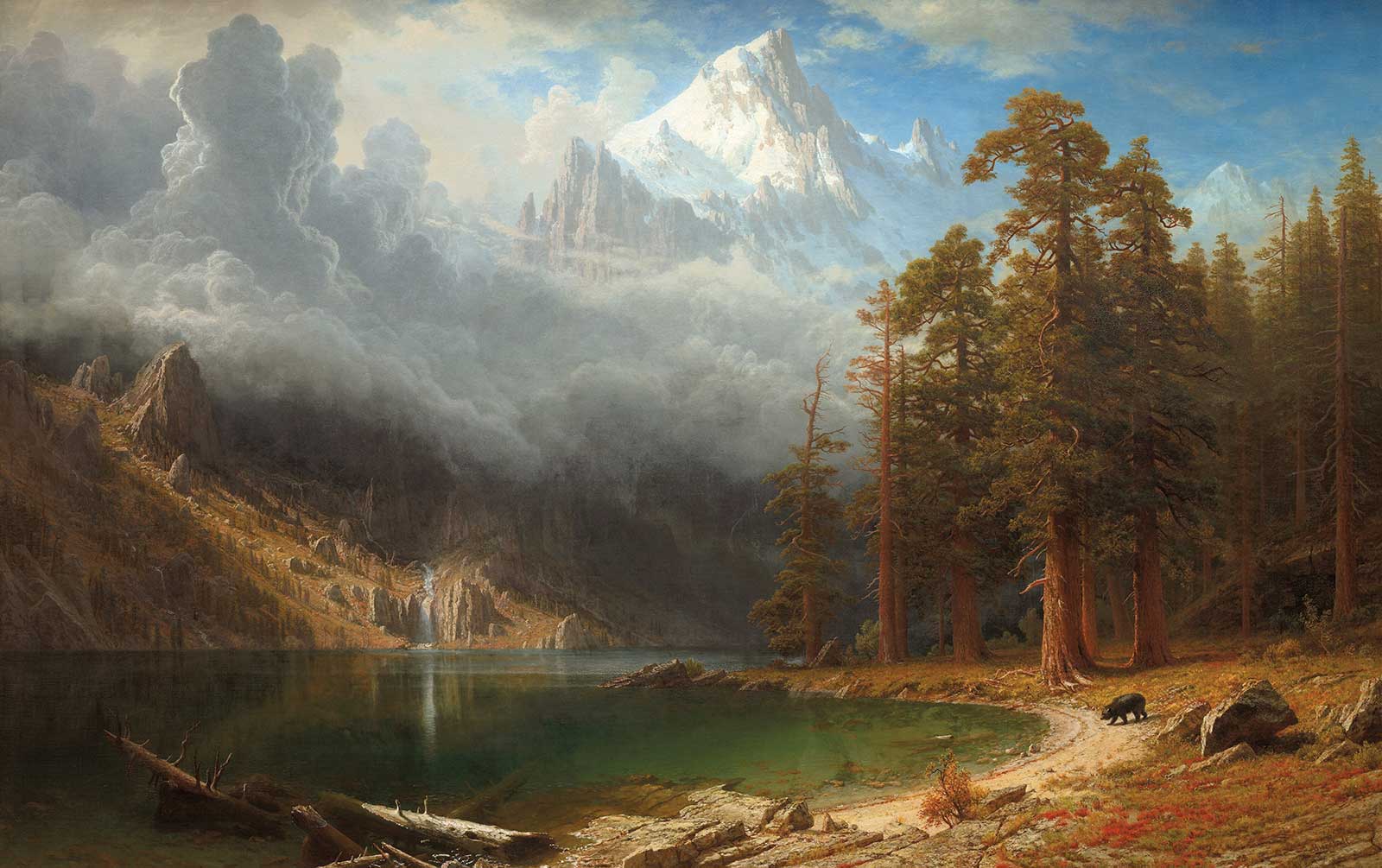
Albert Bierstadt (1830-1902), Mount Corcoran, ca. 1876-1877, oil on canvas, 6011/16 x 957/8 in. National Gallery of Art, Washington, D.C., Corcoran Collection (Museum Purchase, Gallery Fund).
She relates, “Originally established as the Rockwell-Corning Museum—a partnership between collectors Bob and Hertha Rockwell and Corning Glass Works (now Corning Incorporated)—the museum quickly grew beyond the Rockwell family’s foundational gift of their personal art collection. By 1981, with the collection expanding, the museum became known as the Rockwell Museum.
“In 2000, as part of the 25th anniversary year, the museum building underwent extensive renovations and a new interpretive focus on historic and contemporary Western art. In 2001, the museum reopened to the public with the rebranded name the Rockwell Museum of Western Art, accompanied by the tagline ‘the best of the West in the East.’ Thirteen years later, in 2014, following an extensive strategic planning and rebranding process, the museum returned to simply the Rockwell Museum. Kristin Swain, executive director at the time, explained the rebranding as ‘not a re-invention of the museum, its programs, exhibits or the collection. The name consolidation is a rebranding device to help show the other side of what we have to offer, and to highlight the wonderful work the Rockwell is already doing.’”
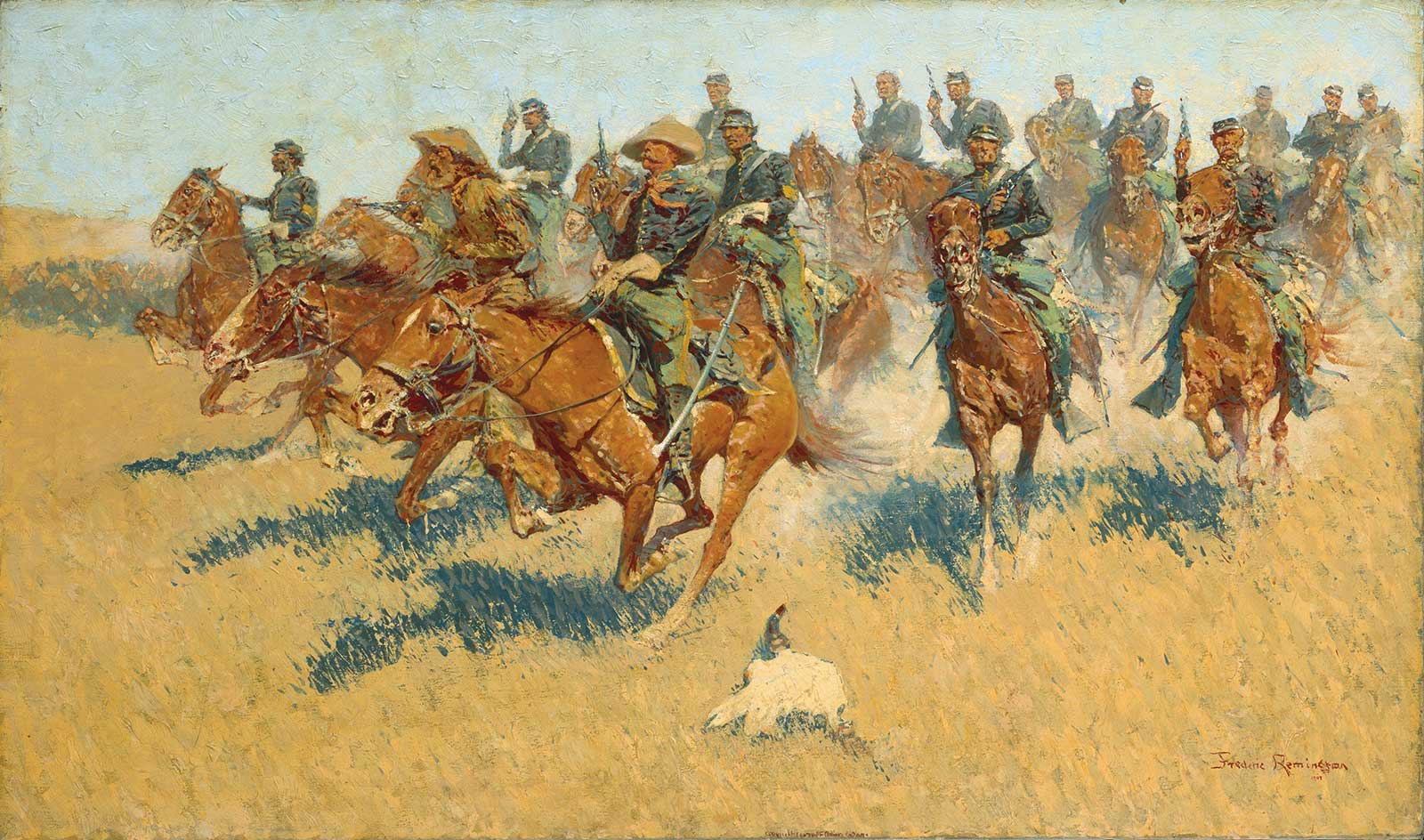
Frederic Remington (1861-1909), On the Southern Plains, 1907, oil on canvas, 301/8 x 511/8 in. The Metropolitan Museum, New York, NY. Gift of Several Gentlemen, 1911.
Coe continues, “This change reflected a deeper truth: while Western art remains important, it represents only 17 percent of the permanent collection. Moreover, defining the museum solely through a West-East lens was limiting and did not capture the breadth and diversity of American art already present in the museum’s holdings. Clarifying the museum’s identity as a place dedicated to interpretation of the American experience through art was essential then, and it remains central today.”
The Rockwell’s curator of collections and exhibitions, Amanda Lett, explains, “Working under the big umbrella of ‘American art,’ means that the curators at the Rockwell Museum have the freedom to interpret the collection through a wide lens. We study the artist’s intent as we develop new exhibitions and gallery installations, and search for connections in style, theme or technique regardless of the identity of the maker. Every work of art acquired by the museum helps us tell a fuller, more informed story of the creative life of the United States.
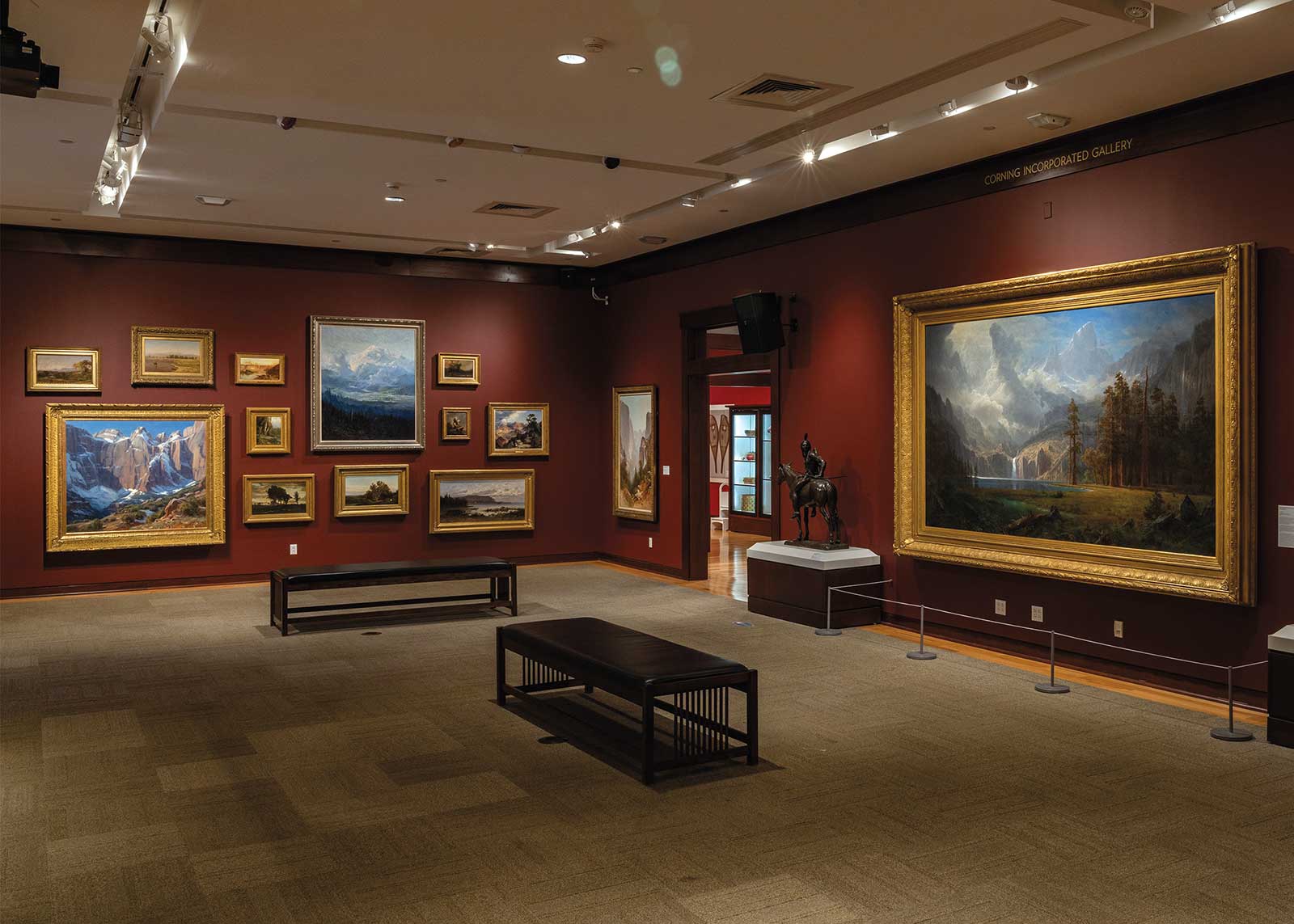
The Rockwell Museum’s Corning Incorporated Visions of America Gallery with Albert Bierstadt’s Mount Whitney, circa 1877, on the right.
“While the museum has one gallery dedicated to the works of Frederic Remington and Charles Russell, we also display the works thematically when appropriate. In the Spring of 2025, for example, we opened an exhibition examining nocturne paintings in the collection. From Dusk til Dawn featured works across a wide range of our collection, including contemporary works of art and works from traditional Western artists such as William Leigh, E. Irving Couse, Ernest Blumenschein and Walter Ufer, among others. While these works are typically on view in the museum’s ‘Southwest Gallery,’ incorporating them into a thematic exhibition gave us the opportunity to speak about the intersection of Western art and American modernism, opening these works up to broader artistic conversations.”
Stuart Chase, who was executive director during the 2000-2001 transformation of the museum, introduced contemporary Native American art as well as weavings from nearby Chimayó, an artistic tradition that came to the region with Spanish colonial settlers in the 1700s.
Chase explains that academia compartmentalized American art and that is the responsibility of museum professionals to “break down those silos.” “Everybody comes to the place with a different set of information and interests,” he says. “It’s the job of the curator to engage and draw them into other areas they don’t know about—to learn more, to make them curious. We need to find the sparks that will engage them and make them want to come back again.”
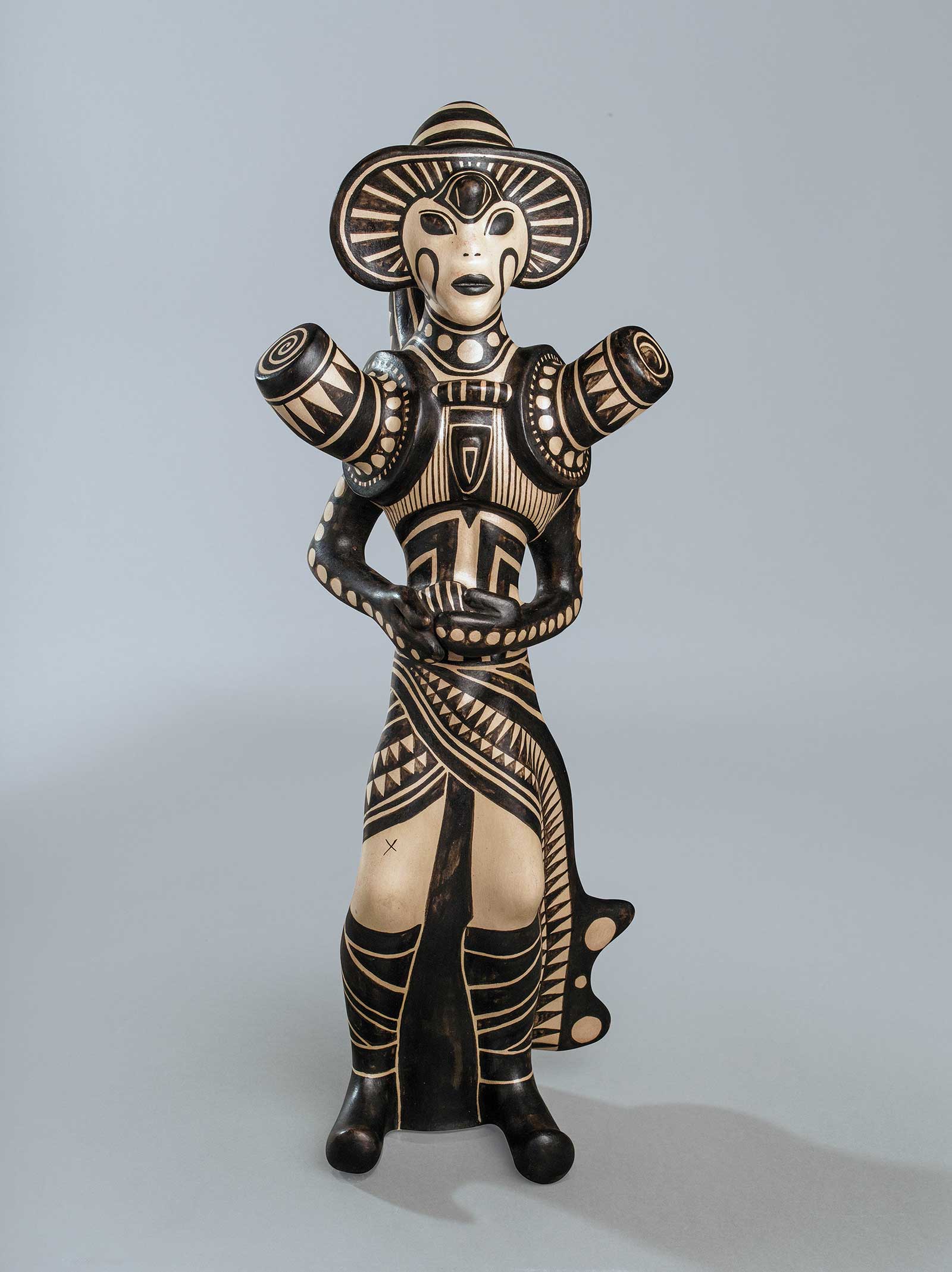
Virgil Ortiz (K’uutim’e) (Cochiti Pueblo), Ancient Elder Figure / Pueblo Revolt 1680/2180 Series, 2012, polychrome ceramic, 20 x 7½ x 2 in. The Rockwell Museum, Corning, NY. Purchased with Funds from the Silver Dollar Society in memory of Bryan J. Lenahan. 2014.6.1.
Earlier this year, the Rockwell presented the exhibition Stephen Towns’ Private Paradise: A Figurative Exploration of Black Rest and Recreation. Towns, whom we featured in the September 2022 issue of American Art Collector, creates paintings and quilts that are inspired by Black American history.
A ceramic sculpture by Virgil Ortiz (Cochiti Pueblo) was acquired by the museum in 2014. Ancient Elder/Pueblo Revolt 1680/2180is part of the artist’s series of artworks on the Pueblo Revolt of 1680. He explains, “The Pueblo Revolt, the first American revolution isn’t taught in American schools, nor is it in our history books. My mission of nearly two decades is to create a narrative of the revolt utilizing the various mediums I work with and make it more interesting and relevant to the next generation.”
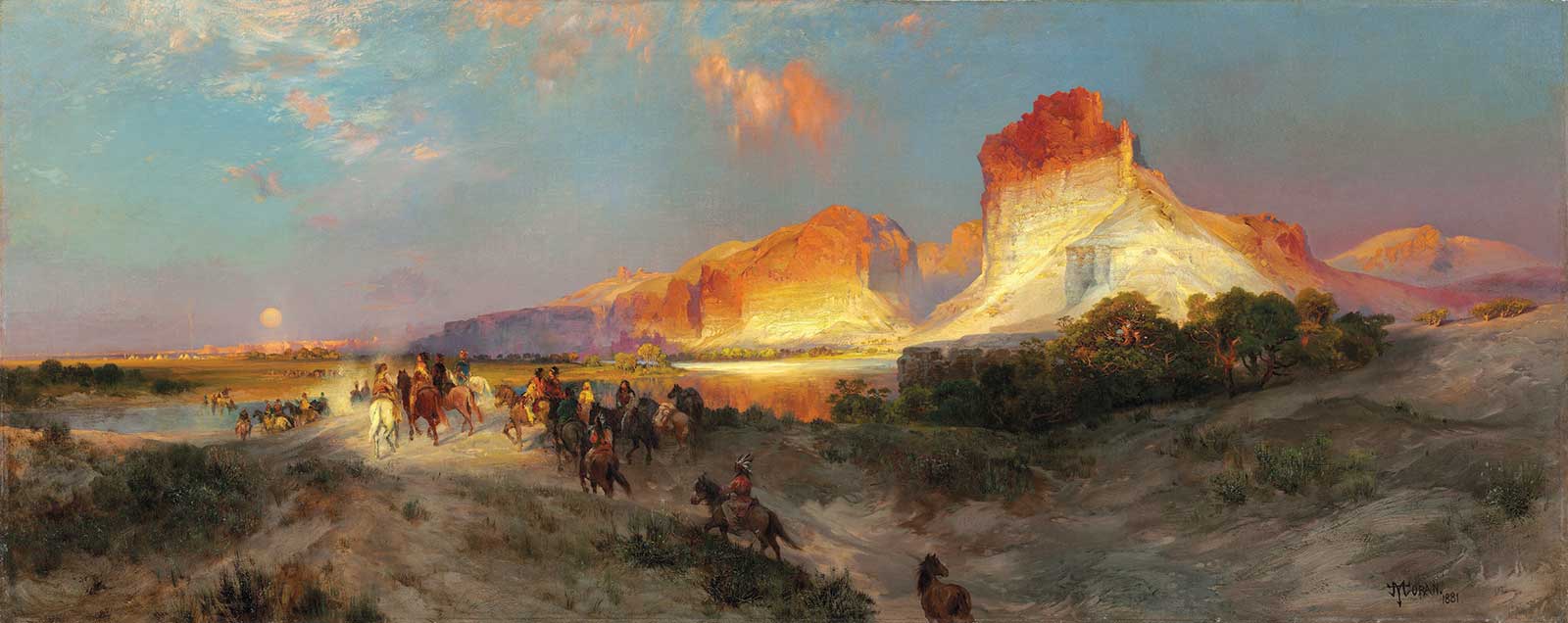
Thomas Moran (1837-1926), Green River Cliffs, Wyoming, 1881, oil on canvas, 25 x 62 in. National Gallery of Art, Washington, D.C., gift of the Milligan and Thomson Families.
Referring to the museum’s continuing collaborations with Indigenous artists, Amanda Lett relates, “We are very artist-led with our labels and interpretation, so the question of considering an artist ‘a Native American artist’ versus just an ‘artist’ is not something we determine. It is based on the artist’s preference.” Fritz Scholder’s Yakima and Shadow, 1976, is in the collection. An enrolled member of the Luiseno tribe, he often said he was not Indian.
The romance of the West and its abundant wildlife is depicted in several paintings at the Rockwell by Carl Rungius, including his Elk Herd, circa 1922.
The romance of the Western landscape, including Albert Bierstadt’s Mount Whitney, circa 1877, is on view in the Corning Incorporated Visions of American Gallery. Bierstadt was notorious for exaggerating aspects of his detailed landscapes to increase their almost supernatural allure.
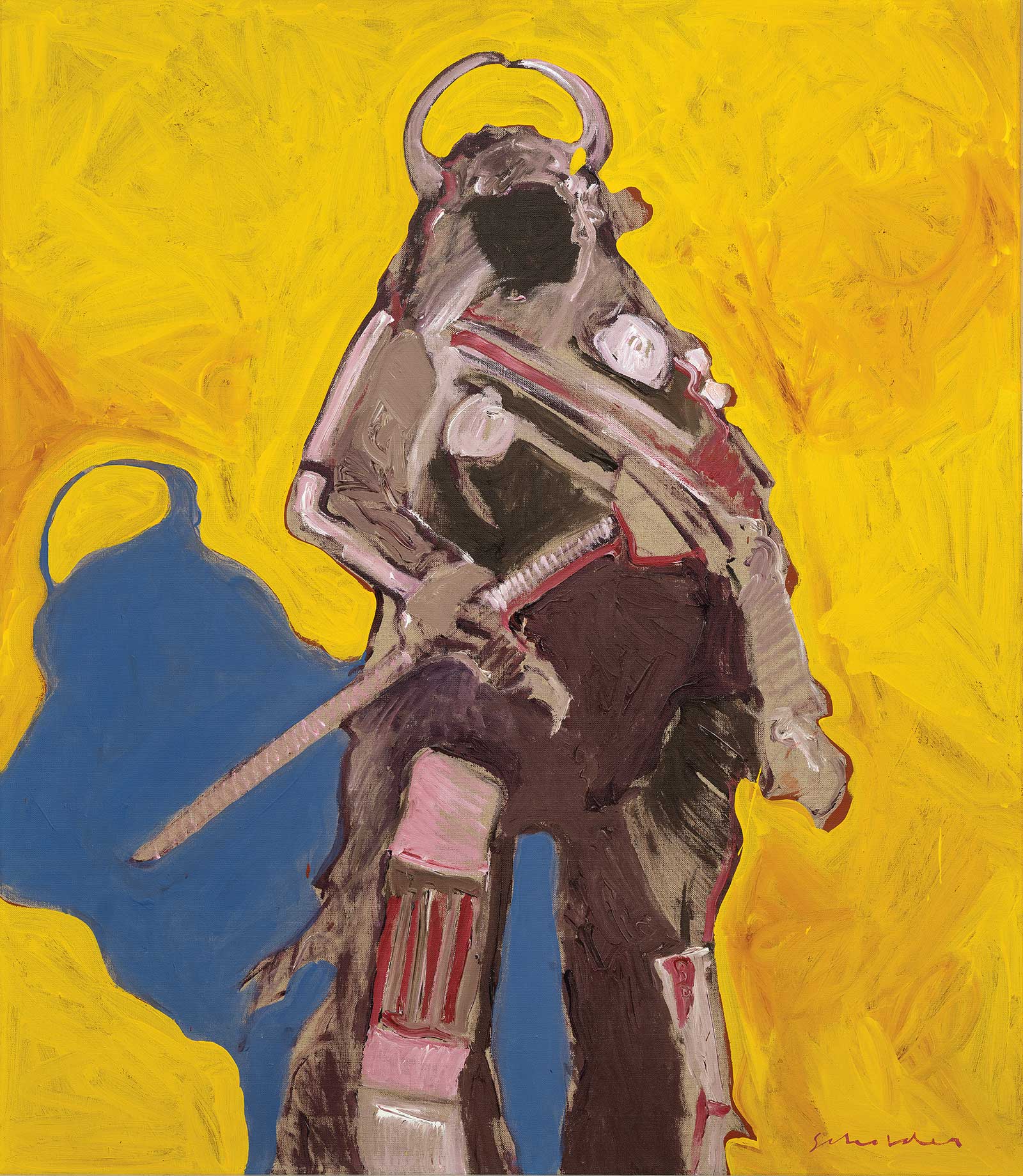
Fritz Scholder (Payokawichum (Luiseno), 1937-2005), Yakima and Shadow, 1976, acrylic on canvas, 40 x 35 in. The Rockwell Museum, Corning, NY. Museum Purchase. 2008.2.
Bierstadt prevaricated so much that the National Gallery of Art says of its Mount Corcoran, circa 1876-1877: “Despite the specific title and convincing sense of place, this scene is imagined. Bierstadt first exhibited the painting as Mountain Lake but changed the title to entice Washington, D.C., collector William Wilson Corcoran. The artist even supplied a map showing the supposed location of Mount Corcoran. The flattery worked. Corcoran purchased the painting, his first by Bierstadt, in 1878.”
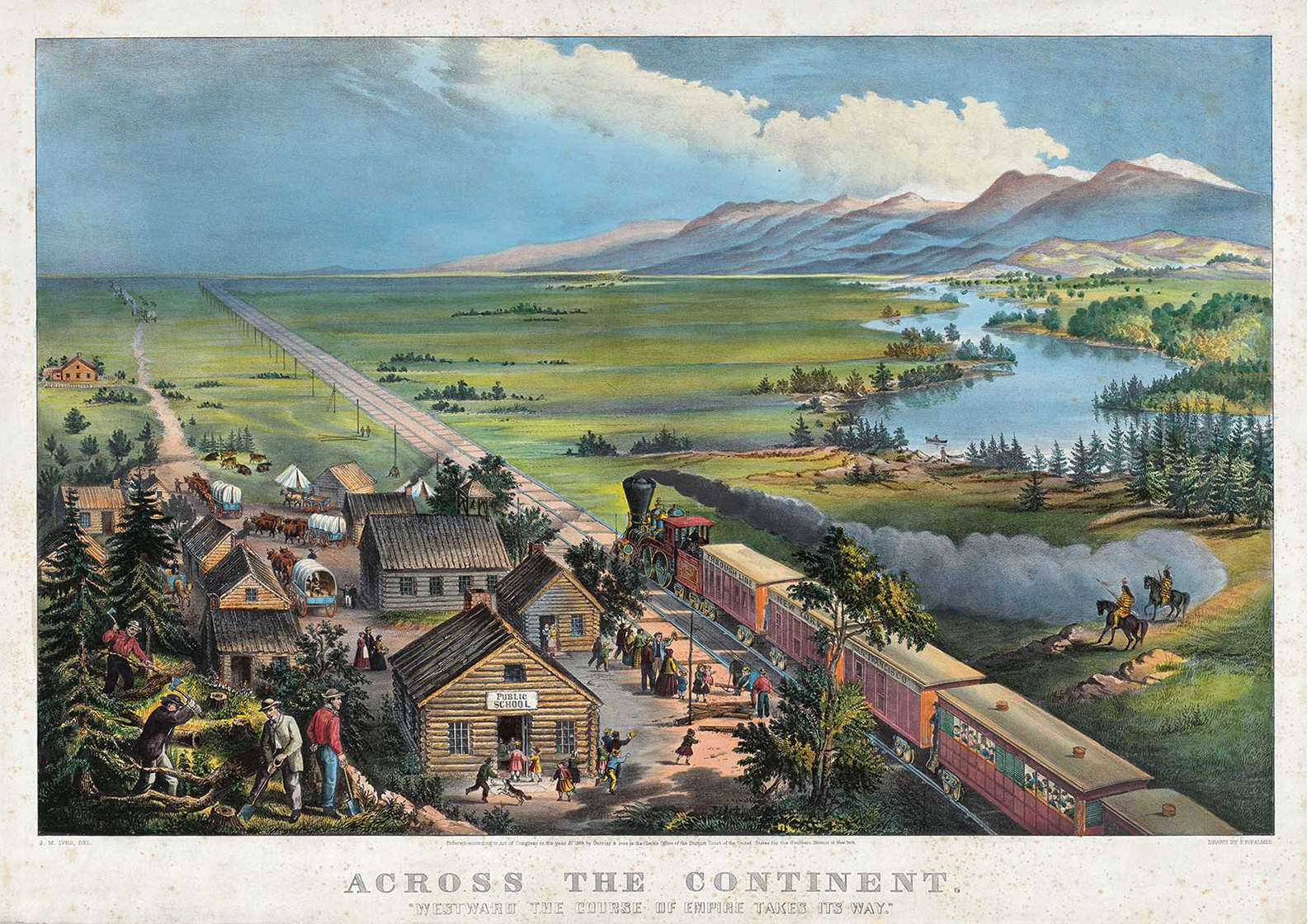
Frances Flora Bond Palmer (1812-1876), Across the Continent: “Westward the Course of Empire Takes its Way,” 1868, hand-colored lithograph with touches of gum arabic, on wove paper, 17½ x 273/16 in. National Gallery of Art, Washington, D.C., Collection of Mr. and Mrs. Paul Mellon.
The National Gallery doesn’t have a gallery dedicated to Western art but draws from its extensive collection for theme exhibitions and K-12 teaching packets. “Manifest Destiny and the West” is part of its Uncovering America series and includes Bierstadt’s Mount Corcoran.
Even Thomas Moran, whose paintings influenced Congress to establish Yellowstone as the first national park in 1872, wasn’t above prevaricating. The packet includes his Green River Cliffs, Wyoming, 1881. The railroad was under construction at Green River when Moran arrived but the painting doesn’t show it. “Their tent camp quickly became a boomtown boasting a schoolhouse, hotel and brewery. Yet none of these structures appear in Moran’s Green River paintings. Even the railroad is missing. Instead, the dazzling colors of the sculpted cliffs and an equally colorful band of American Indians are the focus. In a bravura display of artistic license, Moran erased the reality of advancing settlement, conjuring instead an imagined scene of a pre-industrial West that neither he nor anyone else could have seen in 1871.”
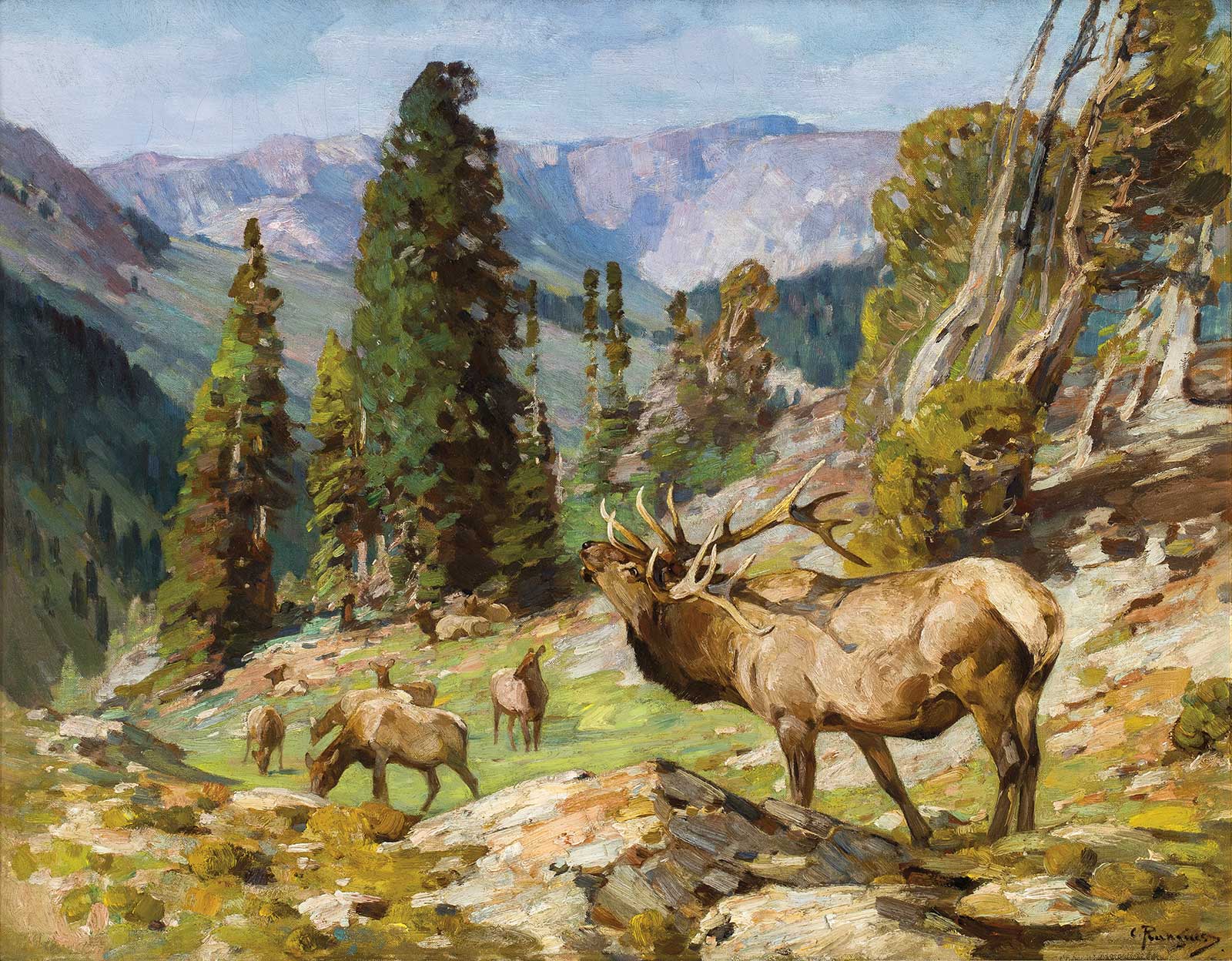
Carl Rungius (1869-1959), Elk Herd, ca. 1922, oil on canvas, 32 x 40 in. The Rockwell Museum, Corning, NY. Bequest of Clara S. Peck. 83.46.24 F.
One of the unsung heroes of the packet is Frances Flora Bond Palmer who produced more than 200 scenes for the Currier & Ives printing company for distribution to the general public across the country. Her painting Across the Continent: Westward the Course of Empire Takes its Way, 1868, reproduced by Currier & Ives, depicts the arrival of the transcontinental railroad and the seemingly endless availability of open land to the west, the dream of Manifest Destiny, the belief that the United States was divinely ordained to expand democracy and capitalism across the North American continent. (Today, Native Americans and others view Manifest Destiny as the machine that colonized the West, displaced and killed Indigenous people, and stole land from its rightful owners.)
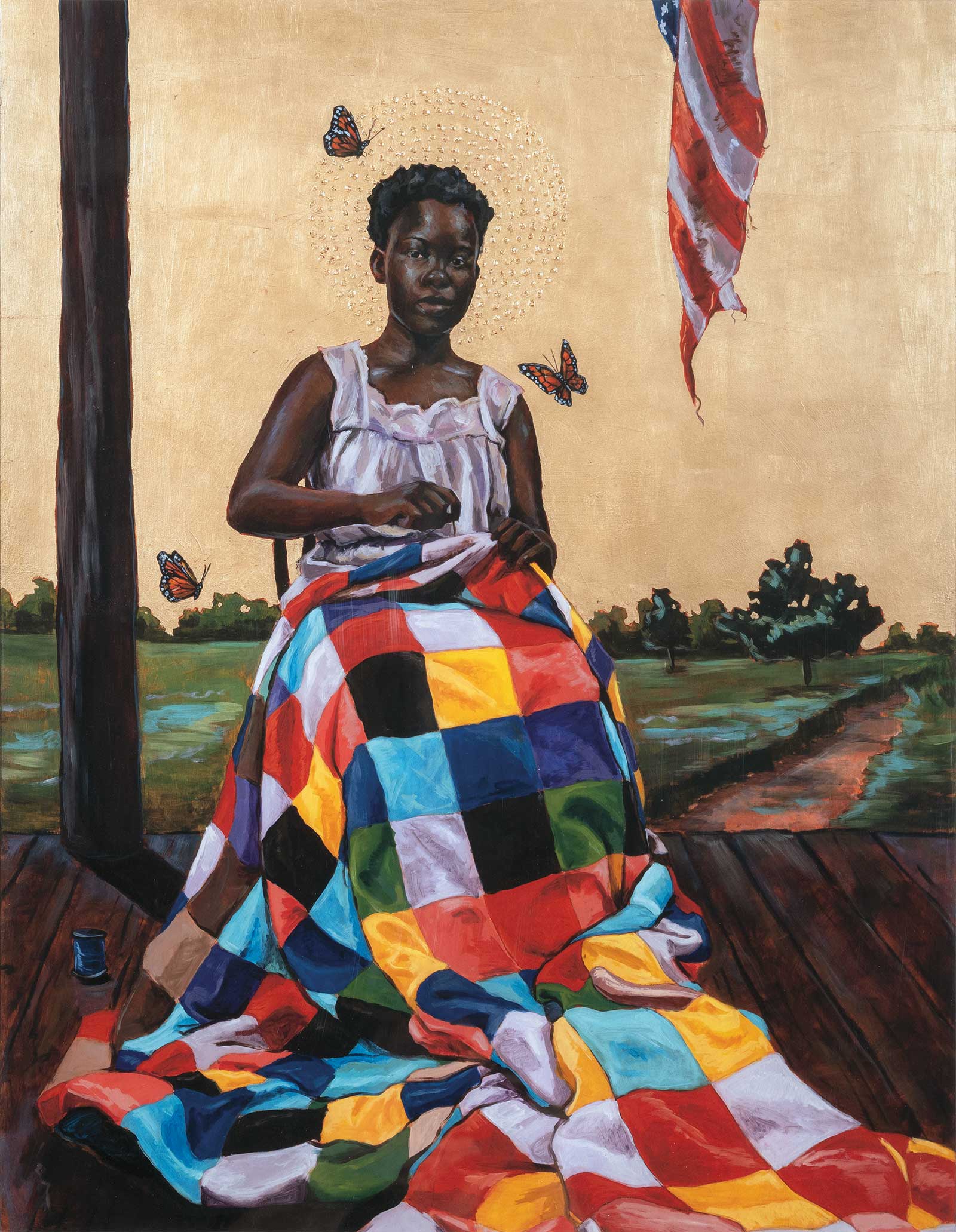
Stephen Towns, I Am the Glory, 2022, archival pigment print on paper, 32 x 24 in., ed. 13 of 20. The Rockwell Museum, Corning, NY. Clara S. Peck Fund. 2022.6.
Depictions of the West would be lacking without cowboys and the educational packet delivers by including Frederic Remington’s bronze sculpture Off the Range (Coming Through the Rye), 1902-1903. The program for students asks questions and provides historical facts. “What was the life of a cowboy really like? Who was a cowboy? The romanticized white, male cowboy may dominate visual media, but in the late 19th century, one-quarter of cowboys were black, American Indians, Mexicans, Latinos and women also held those jobs.”
The packet not only addresses the broad concept of Manifest Destiny, but life aboard a flatboat carrying supplies on the Missouri River depicted in George Caleb Bingham’s The Jolly Flatboatmen, 1846.
The National Gallery of Art is teaching history through the art in its collections, while the Metropolitan Museum of Art has incorporated Western and Indigenous art in the reinstallation of its American Wing. The overall reinstallation is informed by expansive scholarship and a range of curatorial and community voices related to the ongoing redefinition of a broadly conceived American art.
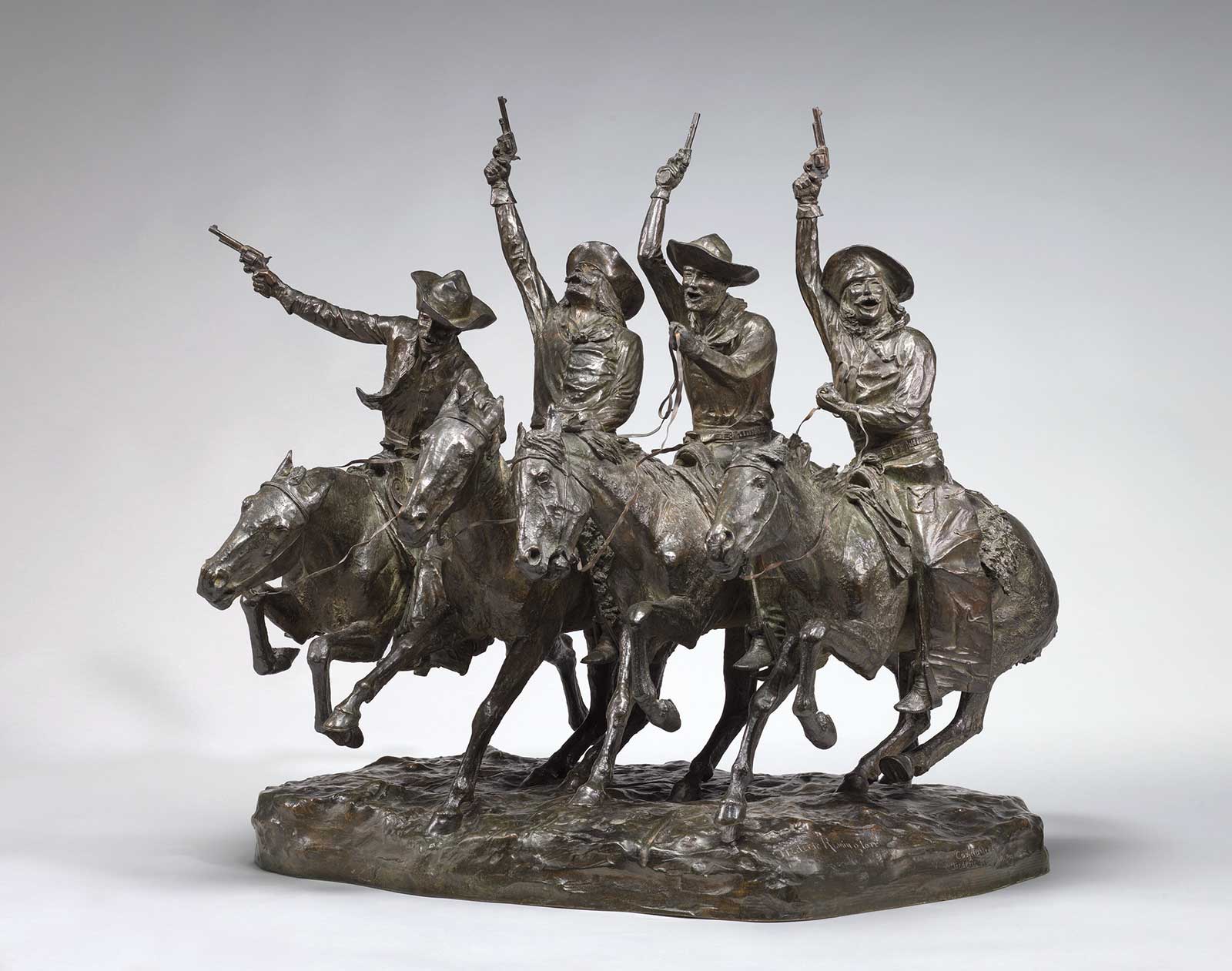
Frederic Remington (1861-1909), Off the Range (Coming Through the Rye), 1902/1903, bronze, 28¾ x 28 x 285/8 in. National Gallery of Art, Washington, D.C. Corcoran Collection (Museum Purchase).
In its description of Western art in the Joan Whitney Payson Galleries, the Met explains, “The artistic legacy of the American West begins with Indigenous makers thousands of years ago. During the 19th century, as Euro-Americans migrated west in search of economic opportunity, so did artists who explored the region’s thematic potential—from the breathtaking beauty of the West’s landscape to its cultural diversity. After the Civil War, industrialization and urbanization fueled a market for artworks that served as visual metaphors for the ‘Old West,’ memorializing a mythic past. These works often ignored historical realities, such as U.S. government policies that forced the displacement and assimilation of Indigenous peoples, and exploited natural resources. Many Euro-American artists, whether travelers or settlers, perpetuated stereotypes—commemorating Native Americans as noble yet doomed, and celebrating white cowboys as manly vanquishers. Other artists challenged prevailing conceptions of land and lived experience in this vast area, embracing its multiple identities as sources of creative inspiration.” —
Powered by Froala Editor


